
I hope to catch up soon from the last few days. We’ve been on an awesome vacation in Yangshuo with patchy internet. Going back to Shenzhen tonight and to Hong Kong tomorrow.
July 28, 2010
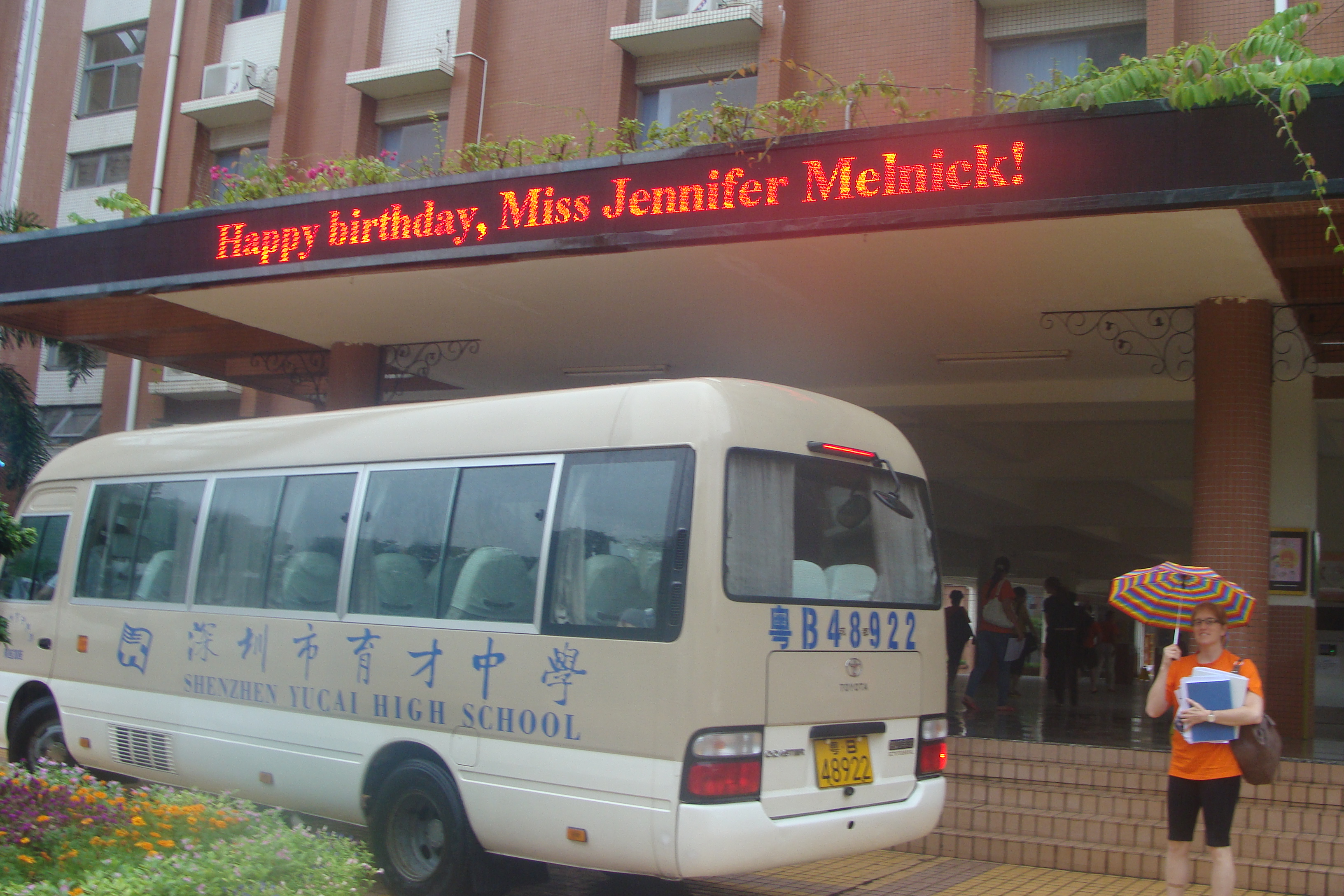
Thank you to everyone who sent birthday wishes! I appreciate it so much! It is so great to have little notes from home while I am here. I am not much of a “It’s My Birthday!” person. I just mentioned it to my roommate, and I was surprised when a few other teachers here wished me Happy Birthday, until someone pointed out that it was posted on our school marquee. So much for keeping it quiet.
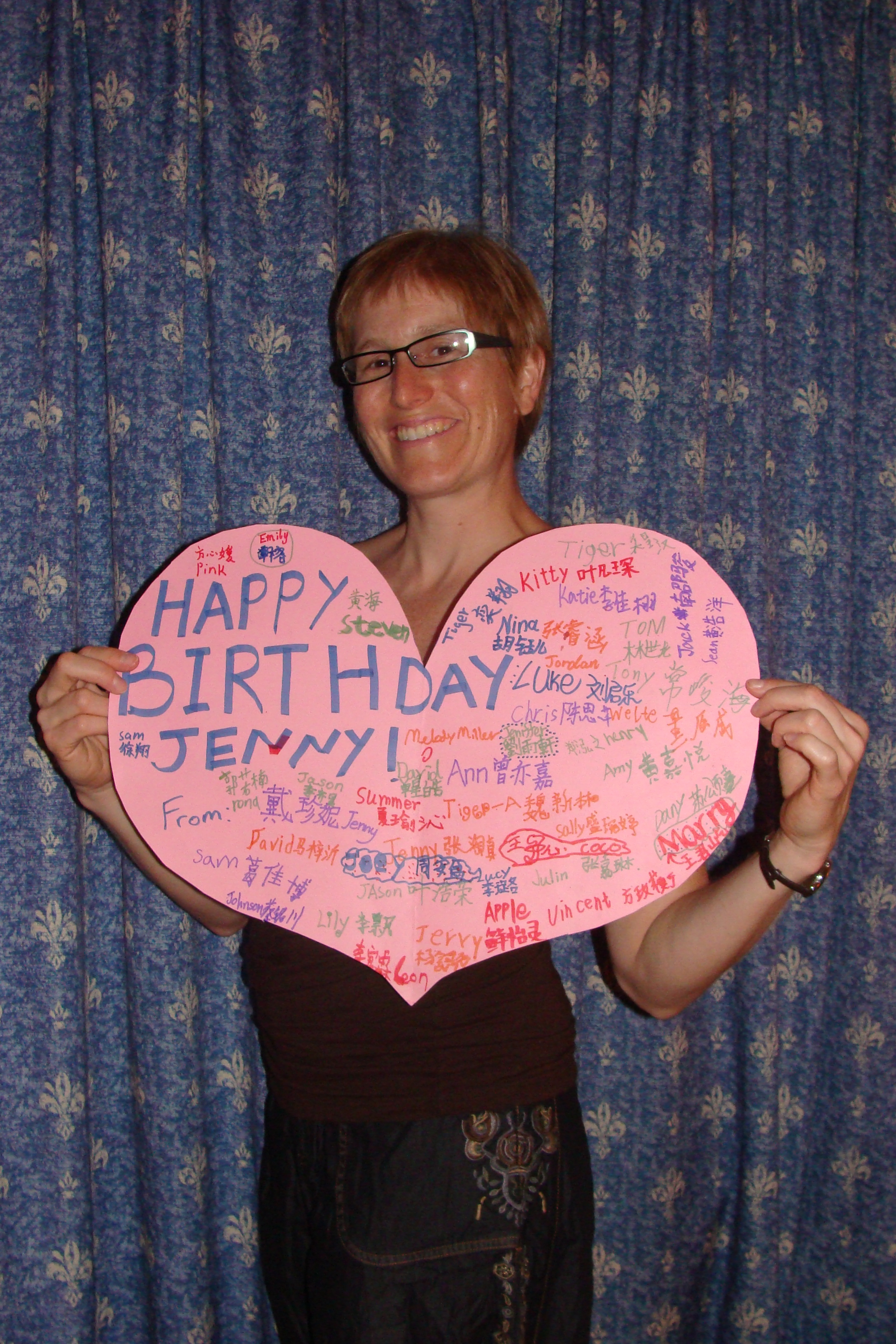
I did have a very nice birthday. I nearly bit off a colleague’s head when she was fifteen minutes late to a meeting this afternoon, but it turns out she was finishing up a birthday card which they had all of our A-group students sign it. Oops. They all wrote their English and Chinese names, so it’s a pretty great memento.
Patti, Nikki, Susan, Ann and I went to dinner at the restaurant my host family had taken me to over the weekend. It had been so delicious, and since I’m not much for cake, I thought their fried bread would be a terrific substitute. (I had Joe’s mom write out the Chinese words for fried bread just in case I made it back there.) I warned the group there was the possibility we would only be able to order fried bread for certain, because the only menu I had seen there was only in Chinese. Everyone agreed to a mystery meal if necessary, but they had a copy in English, which was almost disappointing, though not quite.

Unlike in the U.S., the Chinese servers hand you the menu and then don’t leave. They (2 servers for five people) stand there with their pen poised, making us feel like there must be something wrong with us for not having our order figured out already. While I was flipping through the vegetable dishes in the back, one of them impatiently grabbed the menu from me and flipped back up to the front, pointing to the picture of the roast duck, like stupid foreigners, here’s what you’re looking for! I did know it was a Peking style restaurant. It turns out many people do come there especially for the duck. We saw at least three other tables having it.
I showed the hovering servers my fried bread note, which gave everyone a breather while I pointed to “sweet” and “salty” and gestured for one of each. We also ordered fried rice, tomatoes with sugar, eggplant with garlic, and mushrooms and vegetables. The thing about this place is that all of these dishes are pretty much the same as what we regularly eat at our hotel, but way, way tastier. The vegetables are fresher, more tender, and not overcooked or too oily.

Patti and I stop eating just long enough to take a picture.
Nikki and Ann had stealthily ducked into a bakery on our way and bought a small cake. Susan and Patti and I had stared up and down the street for a few minutes trying to figure out where they had gone. Both of them have a reputation for getting themselves and others lost, and I had been starting to get worried. I found out later that Susan had been in on it the whole time! She totally fooled me.
Anyway, they pulled out the cake a little sheepishly at the end of the meal because I had mentioned while we were eating how I don’t really like cake. How were they to know? It was fun to get it out and celebrate and try to cut it up and serve it to each other with chopsticks anyway. And, there were a few pieces of fancy looking fruit decorating the top of the cake, one of which was a tomato! Who would pass up a cute little Chinese cake with a tomato on top? Not me! It could be my favorite cake ever!

I bit into it just to make sure. Weren't you thinking a tomato with whipped cream was just what you wanted?
It had rained all day, including some tremendously impressive thunder, but after dinner the rain had stopped and it was actually cool and not too humid out! It was lovely to just wander around looking in shops and not sweating uncomfortably.
But the best thing about my birthday could be that I’m in China. Patti asked me how I felt about being away from home on my birthday. Since my family always traveled in the summer when I was a kid, I feel like there’s something wrong if I’m not away from home on my birthday! Here I am traveling, just like I like.
We are supposed to be modeling American educational methods as we teach at this school. However, this is a little problematic because our group has no clear idea of which American teaching methods in particular we are supposed to be doing, except for thematic units. But our 20 teachers (including some who have not taught before) have a wide range of experiences and ideas about how to teach. There was supposed to be a power point presentation about teaching methods during our short training, which would have been a good overview for us and the Chinese teachers, but we ran out of time to have that discussion.
We run out of time for most discussions, unfortunately, as we race to have a performance at the end of each week. I really want to talk to the Chinese teachers I work with more about what they actually do in Chinese classrooms, because I have no idea what their average class is like, to see if where we really are doing things the same or different. But the only time I get to see them is while I am teaching the class they supervise.
At our camp, classroom management is an issue, and it is totally unclear to me whether the children’s behaviors that I perceive as totally out of control are generally acceptable in Chinese classrooms, or if they are acting out unusually. During lessons, Chinese students will just keep chatting with each other, completely ignoring the teacher, and the Chinese teachers don’t do anything about it. Do they think this behavior is fine, or is it an issue with it being unclear which teacher is supposed to be helping them settle down. Or are the behavior expectations in general unclear? If we stand up to sing a song, many of the children take that as an opportunity to run around the room. I have made a lot of headway in making my expectations clear and training the kids in how to behave in my classroom. But these are second through fourth graders who have been in school before, not Kindergarteners who have not yet had a chance to develop school skills. So are my expectations totally out of line with normal Chinese school expectations, or what?
Here are some extreme examples of some things that have come up this week that would be totally inappropriate in an American school:
In Patti’s class today, they were discussing what it meant to have a talent, and what students to be considered to be their talent. She asked their teacher what his talent was, and he said, “To drink a lot of beer.”
This same teacher arrived at the auditorium with his class for today’s rehearsal and promptly fell asleep. Patti had to wake him up before they left.
Yesterday one of the teachers wore a “Math Sucks” t-shirt to school. When asked, she said she knew what it meant and agreed with it. This was during career week.
A student ran out of the A-level music class this morning. His teacher did not go after him. We all met in the auditorium a few minutes later, where his Chinese teacher told me he went home with his parents. We found him after rehearsal sitting in a classroom by himself.
A student brought a toy gun to school for a prop for career week. You can’t even get a toy gun that looks like an actual gun in most places in the US anymore, but here was a very realistic handgun in a holster. The Chinese staff thought he should keep it in his backpack, if we weren’t going to let him use it for career week, which they thought was strange. The American staff, used to zero tolerance policies about guns, jumped when they saw it
Obviously, China is a different place with different social norms and expectations. But what are they? Sometimes it might be a little different, or sometimes a lot different. When are the Chinese teachers wondering what the heck is up with us?How do we tell the difference between when we are experiencing a little cultural confusion and when something is actually not in the best interest of our students?
Saturday, July 24
*pictures coming some time from Susan’s camera
Today was a lovely day. I tried to sleep in, but couldn’t, so I just lay in bed pretending to be asleep for as long as I could stand it. Several of us had planned to go to the Fairy Lake Botanical Gardens, about an hour bus ride. A group went two weekends ago and had an amazing experience, so we all wanted to go too.
The last few minutes before we left, I was googling to get any extra information I could about how to get there. There was a webpage that had a card to print out that said “Please take me to Fairy Lake.” If only I had any way to print it out. I briefly considered copying the characters, but that would take too long and I would probably get them wrong. I looked at Patti’s papers to the right of my computer and remembered she had a map of Shenzhen. Even though it was only in Chinese characters, I was getting used to the look of the land and thought it might come in useful. If I had to point to our general area to get us home, I could find it on the map.
Under the map was Patti’s brochure from when she had been to the Gardens! Now I had the name of the place where we were going printed in Chinese characters! We were set! Good thing, because we were double-checking the bus route at the hotel desk just a few minutes later, and it wasn’t going well until I showed up with the brochure. Magic! Express bus K113, we’re on our way.
The desk staff told us they thought it would cost 8 Yuan, so we were all ready with exact change as we headed to the bus stop around the corner. The bus pulled up just as we walked up. Instead of a moneybox, there was a ticket lady to pay, with several books of different colored tickets, since the fare depended on the distance. She looked at us like this was going to be difficult. But I pulled out the brochure and pointed! No problem, message received! And it was only 6 Yuan, not 8! On the bus ride, I tried to pay very close attention to where we passed Metro stops. We were hoping to go to Louhu shopping district after the gardens, and I knew I could get us there on the Metro, since it’s at the end of the line.
The ticket lady told us when to get off, and pointed across the street. We had also heard that we could pick up a shuttle there to get up the hill to the gardens. The other group had walked most of the five miles before they were picked up by and English-speaking botanist who had been to Quail Gardens in Encinitas. We were pretty sure we weren’t going to repeat that bit of luck, so we looked for a shuttle. Two very aggressive beggars practically got in the minivan with us as we made arrangements with the driver. We were also approached by a woman with a bag of live turtles. I believe she was selling them for two Yuan apiece. Leah, a florist from Carlsbad and one of our art teachers, wanted to buy some and release them in the botanical gardens. Worried about non-native species contamination, we prodded her to get in the van quickly.
Susan had looked into the layout of the gardens, and had made a plan to go to the Petrified Forest first, then walk down to the Buddhist temple on the grounds, as well as the orchid and butterfly garden. But the driver took us straight to the temple. So we went there first. It was crowded and beautiful and hot. We bought incense and lit it as we had watched the locals do, then stood like we’d observed in front of a large Buddha statue in a gated room, each making offerings in our own way, then tossed the incense into a fire. “There go all of our cares,” said Susan, as they burned to ash. As we walked further into the temple, we realized there were many different Buddha statues in other alcoves, and people make offerings to either all of them or the ones that stand for certain things, I guess.
Susan spotted a small group of people following a saffron-robed monk, so we followed them. We ended up in what seemed like a 3rd story loading dock, looking out over a roof with animals carved on the corners. People were sitting around eating. We walked up to the building, and a woman we had not noticed before handed three Styrofoam bowls of noodles out through the carved screen that made up most of the wall. Susan tried to ask a man standing nearby who to pay by pulling out her wallet. “No money, no money,” he said. Another woman popped out of a door in the wood screen with a to-go box of bundles wrapped in leaves. She put one in each of our bowls. It was a bun wrapped in a leaf, stuffed with pine nuts and vegetables. It was kind of sweet and very delicious. This vegetarian noodle soup was probably the tastiest thing I’ve eaten in China so far!
Our group had been separated, and Leah and Desiree found us and joined us as we finished eating. We showed them where to get the soup, but it was too late. Lunchtime at the temple was over! The screen was closed up tight!
The petrified trees were interspersed with whimsical topiary trees and picnic tables made out of sawed off, polished-top petrified tree trunks, giving the whole area a very fantasyland look. I would not be surprised at all to learn they petrified trees were not in their naturally occurring spots, but had all been moved there and arranged meticulously. As we wandered among the stone trees, we heard a lot of thunder, but it never did rain.
Staff at the paleontological museum at the Petrified Forest helped us determine that number seven on the map was the butterfly garden. Though we were at the top of the lake and it was at the bottom, we decided to start walking. Not long after, we saw our shuttle driver. We decided we didn’t need to have the most tiring day in the world, so we hired him to drives us there and wait for us to drive us back to the bus stop.
There were not many orchids blooming, but there were many butterflies in a large mesh enclosed garden. You could rub your hand on wet sponges located throughout the butterfly enclosure, and the butterflies would land on your hand, attracted to something like sugar water, I assume.
Our driver took us back down to the bottom of the hill, where Leah and Desiree hopped on the bus to return to our hotel. Nikki, Ann, Susan and I took a taxi to the Louhu shopping area. I’m positive I could have gotten us there by public transportation, but the others didn’t want to risk it. It turns out we were quite close, so a taxi worked fine. Our taxi driver spoke some English, as well.
He dropped us off at the Shanghai Hotel, right across the street from the shopping area. We stopped in the hotel to find an ATM, and used their fabulous western-style bathrooms. Not only did they have western-style toilets, they also had toilet paper, which everyone carries around in their purse. On top of that, they had soap and paper towels! The lap of luxury!
We decided to have afternoon tea there as well. It was lovely, and quite a contrast from our lunch at the temple. Two extremes today! We each had a three-tiered platter. We’d ordered the Asian style, so the bottom was shrimp wrapped in crispy noodles and curry samosas. In the middle was a wonderful muffin, a tiny scone, delicious tapioca pudding, and a small dish of slightly spicy but otherwise tasteless black cubes of gelatin. The black stuff is supposed to be very good for you, so I ate it. The top dish was fruit. Yum! It was all very civilized and snooty. The lounge was full of westerners. It was also a very good thing to have a nice rest before getting back on our feet, and it was nice to get to know each other better. The four of us were a very compatible and relaxed traveling group.
Then we went shopping. At Louhu the bargaining was more serious than at Dongmen. They started higher and would go lower, as long as you attempted to leave. I probably did overpay for a few things, but I got some nice gifts for people. One thing I did not buy was a sequined dress with a stand up collar that would have been entirely appropriate for competitive ballroom dancing, and not much else. I could have had one custom fitted or even made, and I have a hard time passing that sort of thing up. Who knows when you might need one? But I did not even go see how much they were selling for. I just eyed them enviously.
We shopped until Susan and I spent all of the money we had brought, and then we hopped on the metro to go home. This was a route I was now familiar with! We switched to good old number 70 bus, now practically routine. About ten minutes into our ride, the bus stalled just before a bus stop. The driver got on the phone for advice and started turning the engine on and off. It seemed he couldn’t get it into gear. My group started to get a little nervous. It was about 10:00 at night. But we had only been there a few minutes, and we had seen a second number 70 bus in the bus station, waiting to pull around after ours left. We wouldn’t have to try to figure out another way to get home. Sure enough, within another five minutes, the next 70 bus pulled up, and everyone on our bus switched over. They didn’t even have to announce anything.
We got off at our Walmart, and walked the short walk home. The day had flowed quite smoothly.
Update
By admin | July 25, 2010
I have added some pictures to “The Real China.” I used Patti’s camera to photograph my scrolls when she got back from her visit. Check it out.
Sunday, July 25
Yesterday was a fun day touring, which I intend to finish writing about quite soon, but today I had the most amazing experience! From school, it was arranged for us to go on a visit to the home of one of our students. Families got to choose which teacher to invite. I have a very quiet student whose English name is Joe, and I got an invitation from his parents.
Some of the American teachers were apprehensive about having to visit a family—what if the family didn’t speak very much English or it was awkward. Patti actually put many concerns to rest by insisting to our Director, Beth, that she tell the families dietary restrictions of each teacher. I myself prefer to eat vegetarian, but I also like to be polite to hosts, and I can try new foods up to a certain point. After several weeks of trying to figure out if a dish was intestines or eggplant without any reliable way to translate, it was very comforting to know that I could just let them know in advance that I would not like to eat meat. As it turns out, Joe’s grandfather was also a vegetarian, so we had a wonderful lunch together.
To start, Joe (his Chinese name is Li Rong Da) and his parents picked me up at the hotel. During last week where we talked about careers, our stories teacher said Joe was writing a book about construction workers, because that was what he wanted to be when he grew up. The day after that, Joe came to school with a note tucked into his name tag that said, “Joe wants to be an architect when he grows up!” In the car, his mom helped him tell me about his favorite tall buildings. He is a very shy child who rarely speaks at school, but he can say “skyscrapers!” He loves the Sears Tower, and the Empire State Building, and the Bank of China building in Hong Kong, and the Taipei 101! I had met Joe’s dad Friday at our performance, and his English was not that clear. His mother speaks English beautifully, it turns out. She works in a bank, and often does projects with English-speaking clients. She told me that his dad is an investor, a stockbroker. He has a Master’s Degree, and apparently has done much studying in English—his reading and writing is excellent, but his spoken English is not so good. He has so few chances to practice speaking in English. Since I have a degree in German, but never get to speak it, I certainly understand that! It is very hard to learn and keep up a language when you live in a place where most people do not speak it.
Their apartment is on the 7th floor of a seven-story building, which is quite short by Shenzhen standards. They apologized for not having an elevator, but I try to take the stairs, rather than the elevator, several times a day to our 5th floor hotel room, so I have been practicing. First, Joe showed me his collection of 3-D puzzles of all of the skyscrapers and some other buildings he loves. In addition to the ones he had mentioned, there was also a hotel in Dubai and a castle from Germany. He still had to punch out the pieces and build his newest, the Pearl Tower from Shanghai. Then he went to work on a special gift for me—it turns out he also loves archeology, so he got a mysterious gift for me. It was a toy that was a block of plaster and a chisel and a small brush. You have to excavate it to find out what is inside! Joe happily chiseled away on the porch while his mother and I talked. When he finished, he proudly brought me the replica artifact that he had “unearthed.” While Joe pantomimed ringing a bell, his mother looked up the Chinese word on the internet so she could tell me it was a chime. It also came with a small book that told more about the history of this sort of chime, in Chinese, of course. She told me it was of the style that is more than 2000 years old. To ring it, you hit it with a stick. Joe’s dad described how they would be lined up by size to make different sounds, like the inside of a piano. The book has a great diagram pointing out the different parts, but unfortunately they were mostly technical terms that Joe’s mom didn’t know the translations for. But, I love it!
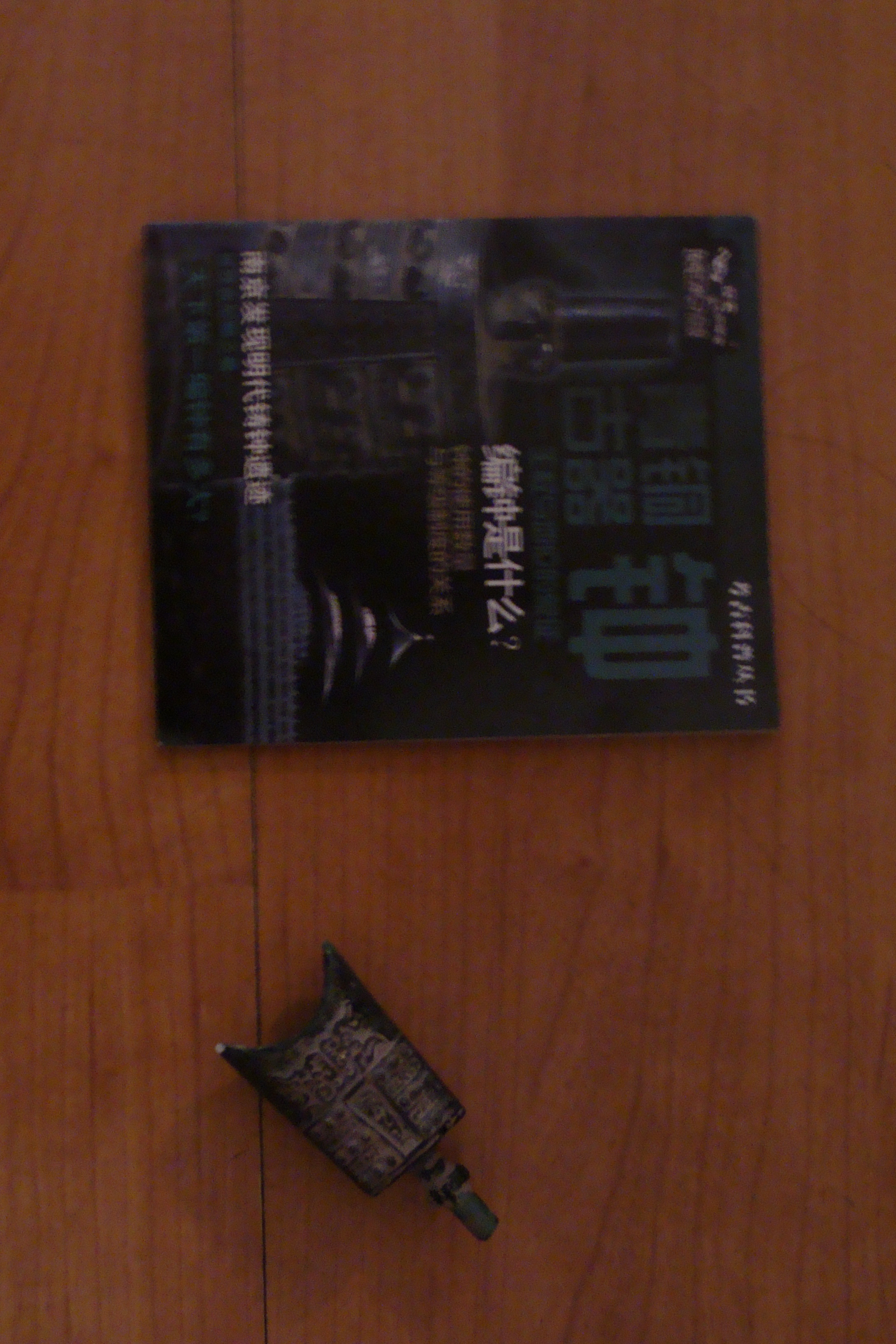
Here is my mysterious present after the excavation!
Joe’s dad brought out tea and fruit. We had longan, which to me looks like a small lychee and tastes similar, but they did not think they were very similar. There is a big seed in the middle, and they are also known as “eyes of the dragon,” because the fruit looks a lot like an eyeball. We also ate pitaya, which is beautiful on the outside and white with black seeds on the inside. I had seen it many times in the grocery store, but had no idea what it was like. It does not have a very strong flavor, but it tastes like a very subtle kiwi fruit, I think. We also ate Hami Melon, which is very similar to cantaloupe. Joe’s mom showed me on the globe how it comes from the far northwestern region of China, very close to Kazakhstan. She also showed me a list of words she had translated for the day to make sure she knew how to say them in English. Pitaya and longan, for example, which was interesting because I had never heard of those before anyway, but it was so thoughtful! We also looked at the globe to see where San Diego was.
Hai Yu, Joe’s mother, had many questions for me about teaching Joe to read in English! She had a huge library of English children’s books that she has been collecting. She had many sets of leveled readers, as well as many picture books and chapter books. She was starting to worry that the leveled readers were too boring to want to read, and the other books were too difficult, but she loved the stories so much. Frog and Toad was one of her favorites! From what I could tell at school, the Chinese way to teach is with workbooks and repetition. She seemed to confirm this. We talked about the difference between phonics on a worksheet, phonics in a pattern book, and how to teach phonics by reading great stories or looking at the names of your friends and family. She said that Chinese children also learn a lot about the Chinese language from each other’s names. She said she thought her ideas were very different from most Chinese parents.
She also said she thought it was most important in English class to speak in English, even if it is about everyday things, rather than to learn new things. This is exactly what I have always learned about English Language Development teaching, and what has not been planned for our summer camp. I have been trying to explain about this to our director. I think it would be much more effective. Otherwise, the children are just memorizing vocabulary about biomes, careers and world cultures, the three themes of our camp, instead of really learning to speak. The older students who have been learning English for many years are doing better with this content, but I do not think it is right for the younger students.
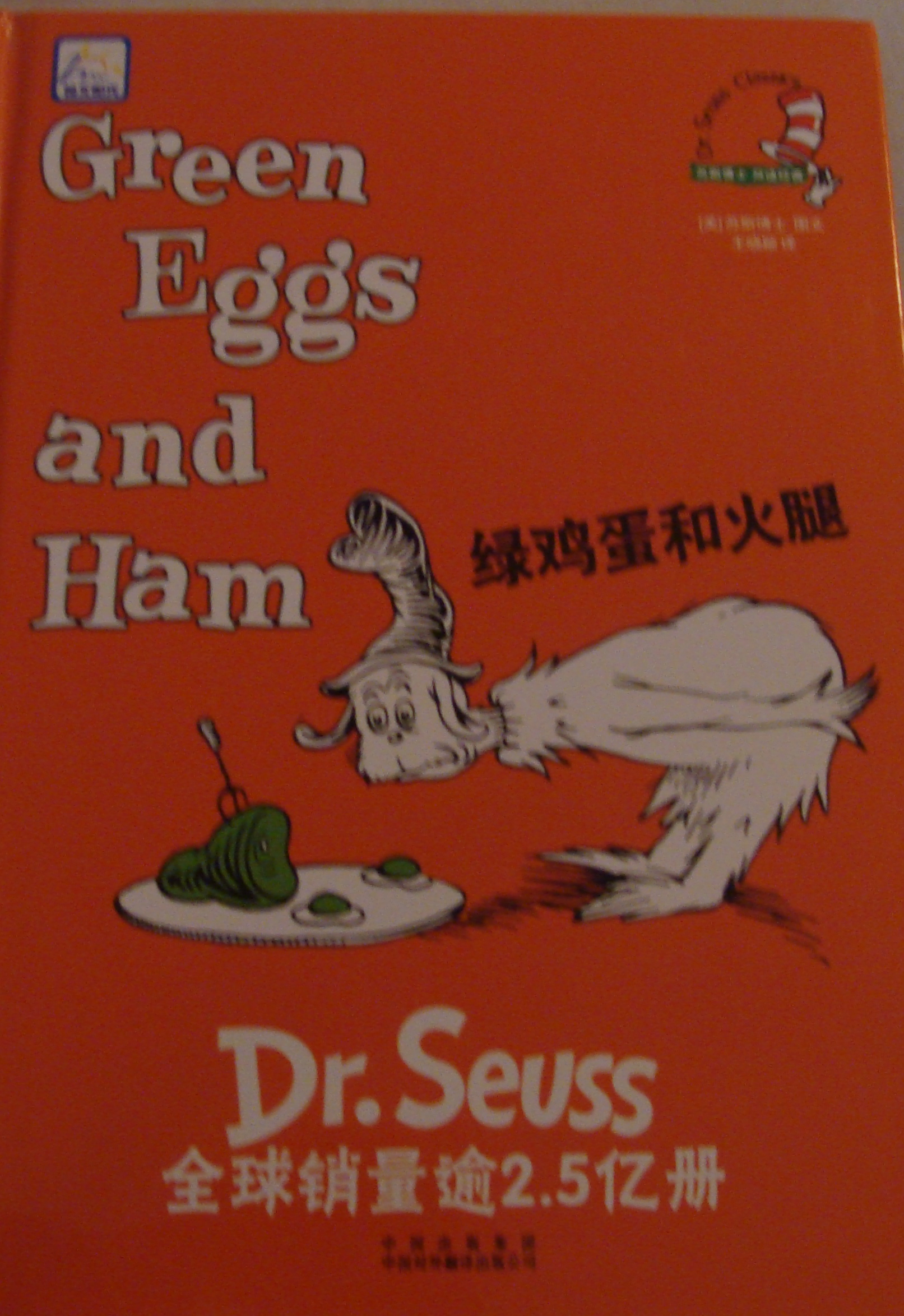
Anyway, we had so much fun looking at the books in her collection. She has Dr. Seuss and Calvin and Hobbes too! Joe wanted us to watch the Monkey King cartoon. It is a traditional story from China. But by the time we finished looking at the books, he was watching a live action Monkey King on the computer, and was not interested in the cartoon anymore. We tried to watch both for a few minutes, but that didn’t really work out. Hai Yu brought out Joe’s monkey king crown that his grandfather had made him! I don’t know if I mentioned yet that my camera has stopped working—it was never so disappointing as today! Hai Yu took our picture with Joe in the crown, so I will post it when she sends it to me.
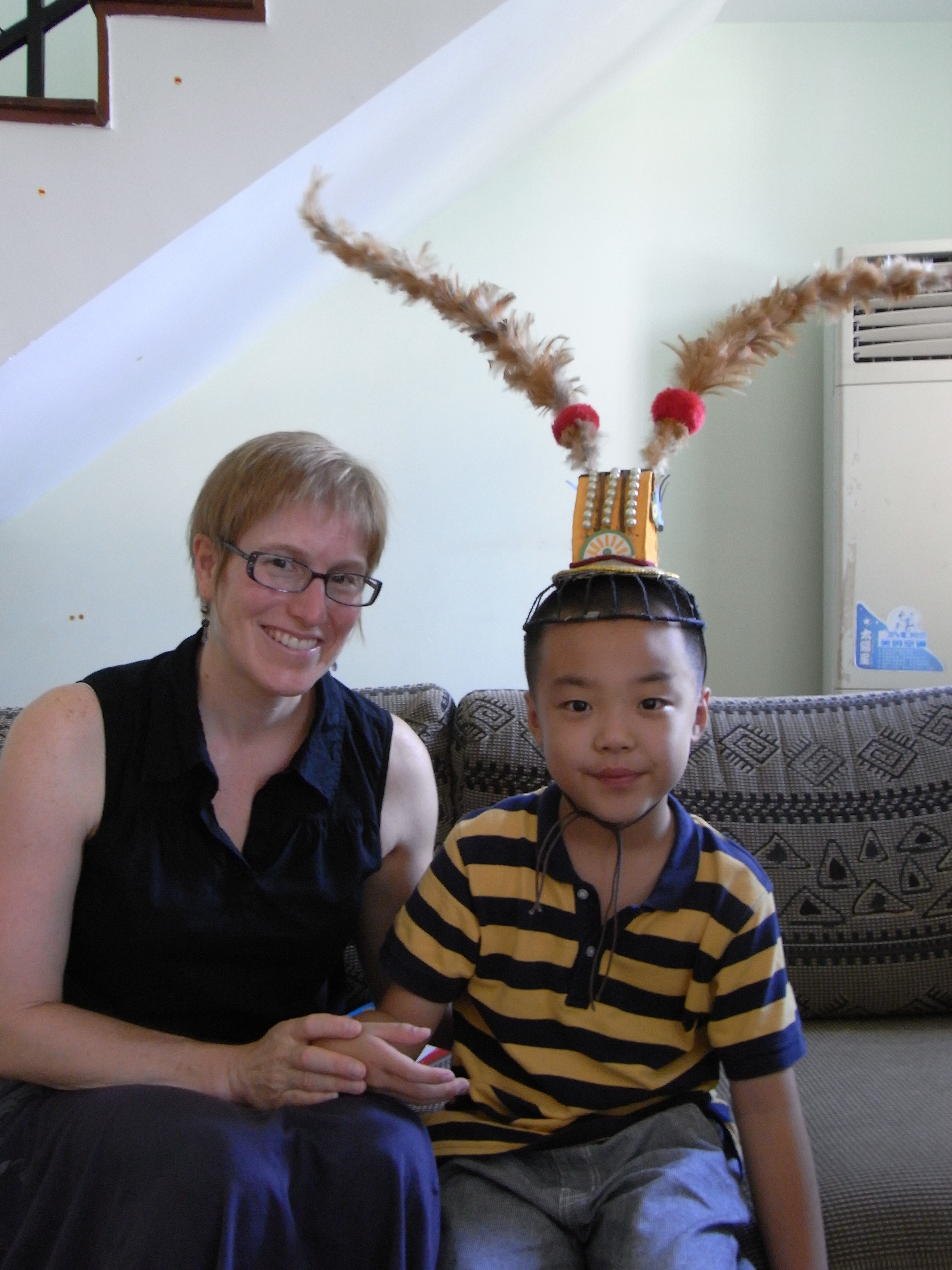
The Monkey King and I
Hai Yu showed me some toys her father had made. They looked like rattles—one was a chopstick with a Christmas ornament on it, and the other was a pencil with a paper polyhedron on the end. They were both painted gold, and Joe showed me how he could twirl them around in his fingers. I showed him how I could juggle with three longans, but I also bumped him in the nose, because I am not a very good juggler. I felt horrible about that. Joe also got a staff and showed off his kung fu moves! Did I mention he is six years old! I told him about my friends who spin staff with fire on the ends of it. Joe also spent quite a bit of time examining a spider on the wall. He really wanted to touch it, he said, but he didn’t dare! He has a great curiosity. He also wanted to show me how he played go, which is like Chinese Chess. He has been playing since he was four years old, and his parents say he is very good at it. Hai Yu said it has helped him become very good at math, which was clear.
She explained how Go is the only game a computer cannot win, because there are so many possible moves. But at the same time, it is exceptionally simple. All of the pieces are equal, unlike the pieces in chess, for example. It also seems you can stop at any time and see who has the most pieces, which is quite different when you compare it to most games that can only end in one specific way.
Hai Yu also showed me some books that gave the history of Chinese Characters. It was so interesting! It gave four historical versions of each character, with a picture of what the character described, as well as some other background information. We flipped through a book about animals and one about nature. It was so interesting to see how the symbol for tiger used to be a picture that looked a lot like a tiger. The one for winter looked like a small house with figures in it sitting around a fire. The one for spring looked like running water. The one for man was based on a figure carrying something heavy, and the one for woman looked like a kneeling figure. However, to my eye, the modern characters don’t have any picture information at all.
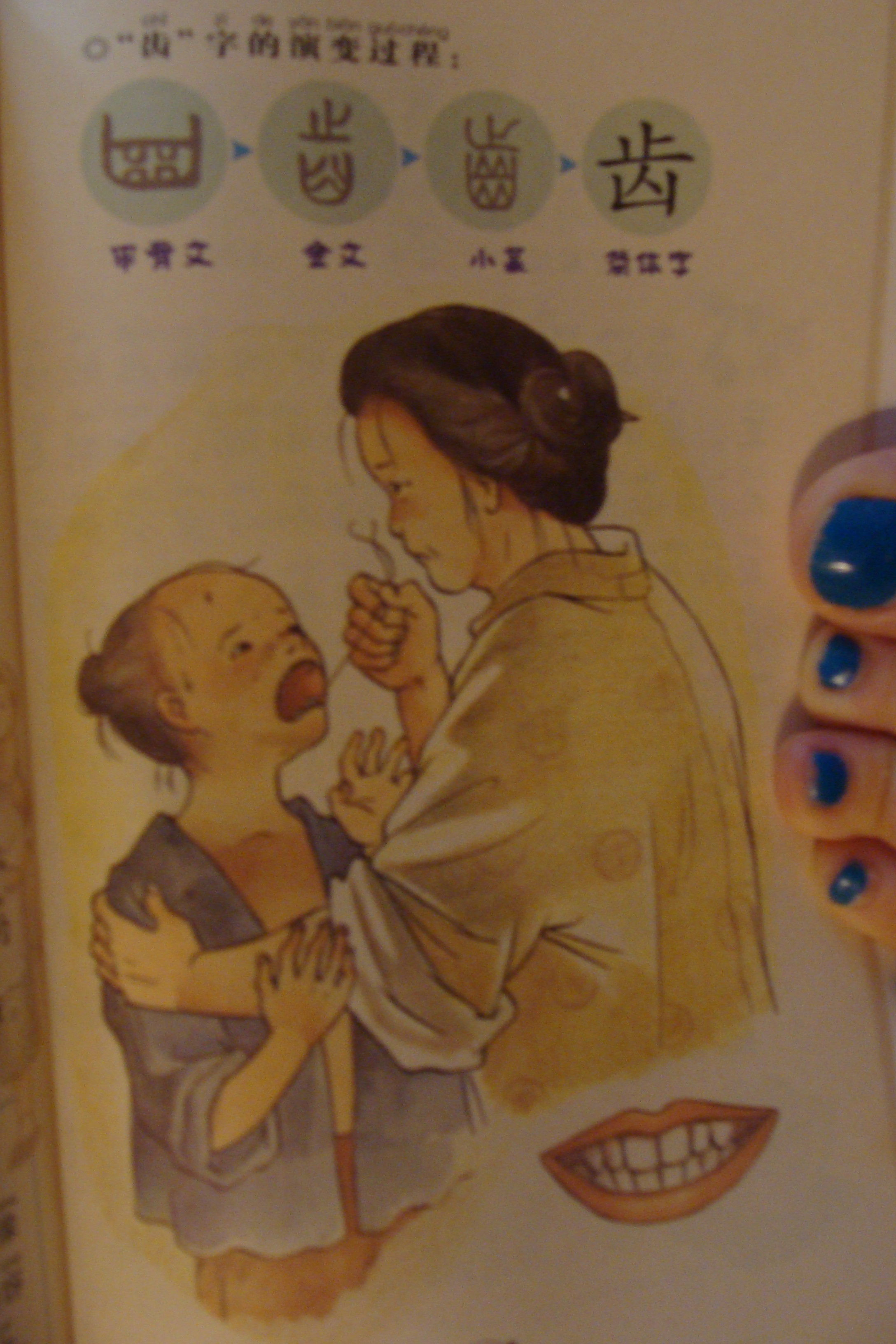
The character on the left is the oldest. What do you think this one means?
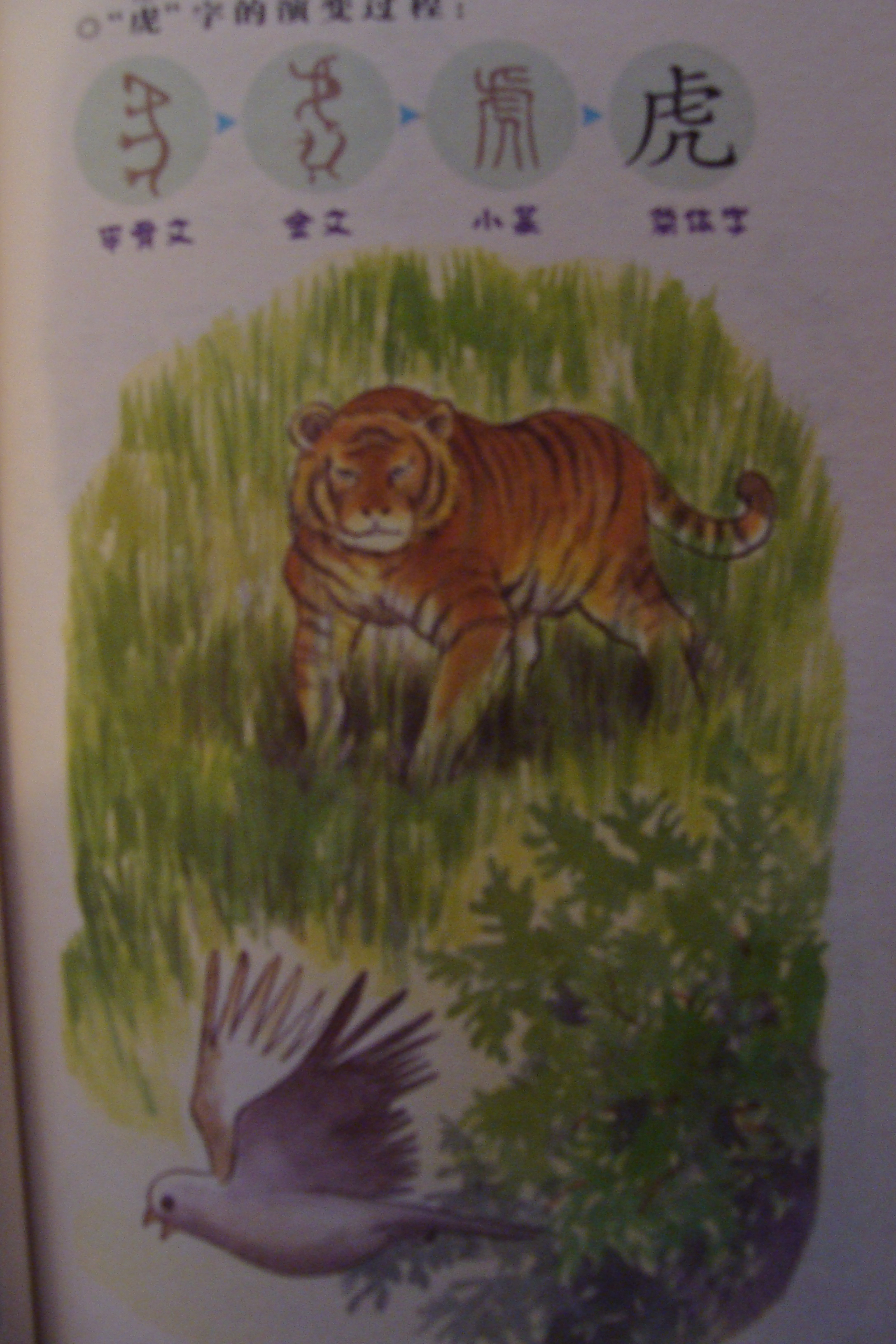
If you look at the first character sideways, it looks more like a tiger.
She also mentioned that Chinese people think English is very complicated, because there are so many words! (She said about 70,000. This Slate article says more.) She said once you know 2,500 key words in China, you can read just about anything. When she put it that way, it kind of makes sense, though at first I thought, there are only 26 letters, and you have thousands of characters. How could that possibly be easier? I guess it really depends on how you look at it!
This history and cultural lesson was fascinating, but it turned out it was also in preparation for a visit to Hai Yu’s parents. They lived just a short walk away. Her father (I’ll call him grandfather) had been a musical instrument importer. Both of her parents were university educated, which was very unusual for their generation. Now that they are retired, her father has many hobbies. One of them is Chinese calligraphy! He was going to give a demonstration for me! Oh, I wish my camera was not broken, and I wish everyone I know had been there! He showed me brushes of many different sizes. Some are several inches in diameter, for making very large posters. He had a large one on the wall that he had made for the Spring Festival, on gold-flecked red paper. Hai Yu explained that it told about families coming together and eating good food and watching fireworks, having a wonderful time. I think it is like a poem, or maybe a word picture would be more accurate.
Grandfather rolled out a scroll of paper about four feet long on his table. He got out a book and chose a saying to write. Hai Yu said it was from a great Chinese educator, and it sounded like she was talking about Lao Tzu. She translated it something like, “If you want to do something big, you have to do the small steps step by step.” This sounds very similar to the proverbs “Great acts are made up of small deeds,” and “The journey of a thousand miles begins with one step,” both of which I found attributed to Lao Tzu with a quick Google search.
The characters are written from right to left in rows. The brush is held straight up and down. It is hard to see how the different widths of the characters are made, but it is lovely to watch! Then, at the end, he wrote the date, the year of the tiger, and his name, all of theses in much smaller characters. Then he got out the box with his chops and the special ink. You don’t just stamp your name carelessly. He carefully considered how the stamp would be placed at the bottom of the row so everything on the page would be arranged just right.
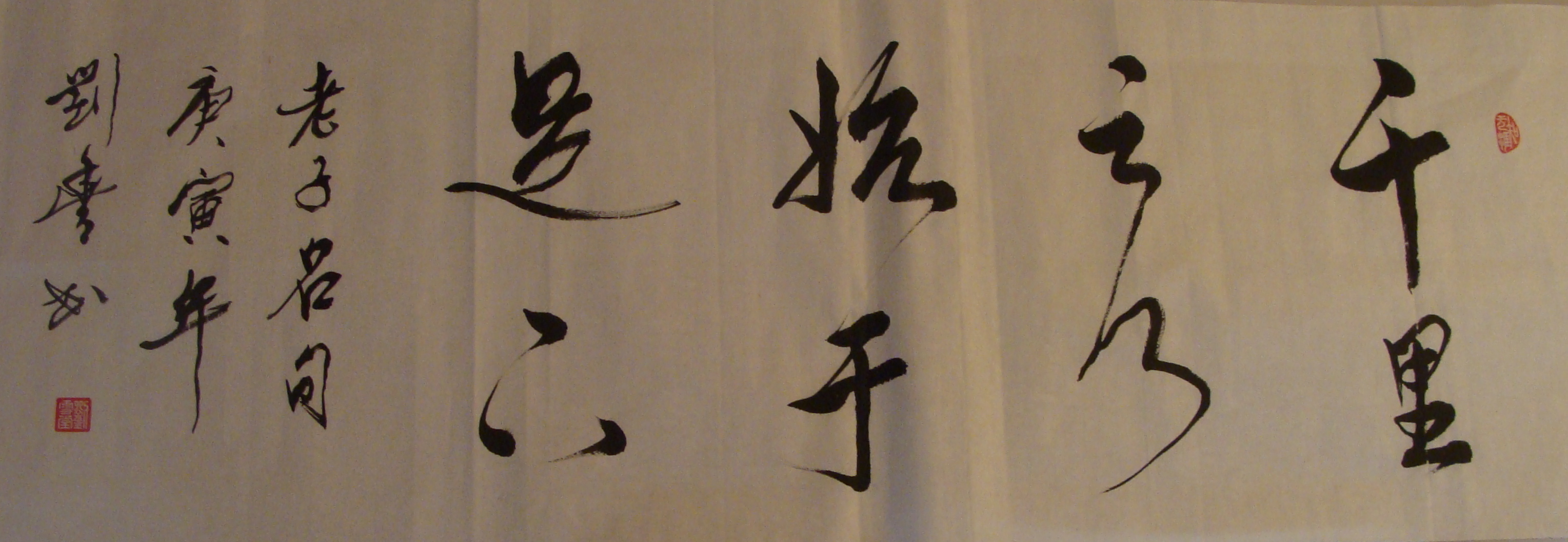
Remember, start on the right and move left.
He took out another chop and stamped it at the beginning of the saying. I think what Hai Yu explained was that this was a stamp that told what was important to the writer, and this one said knowledge.
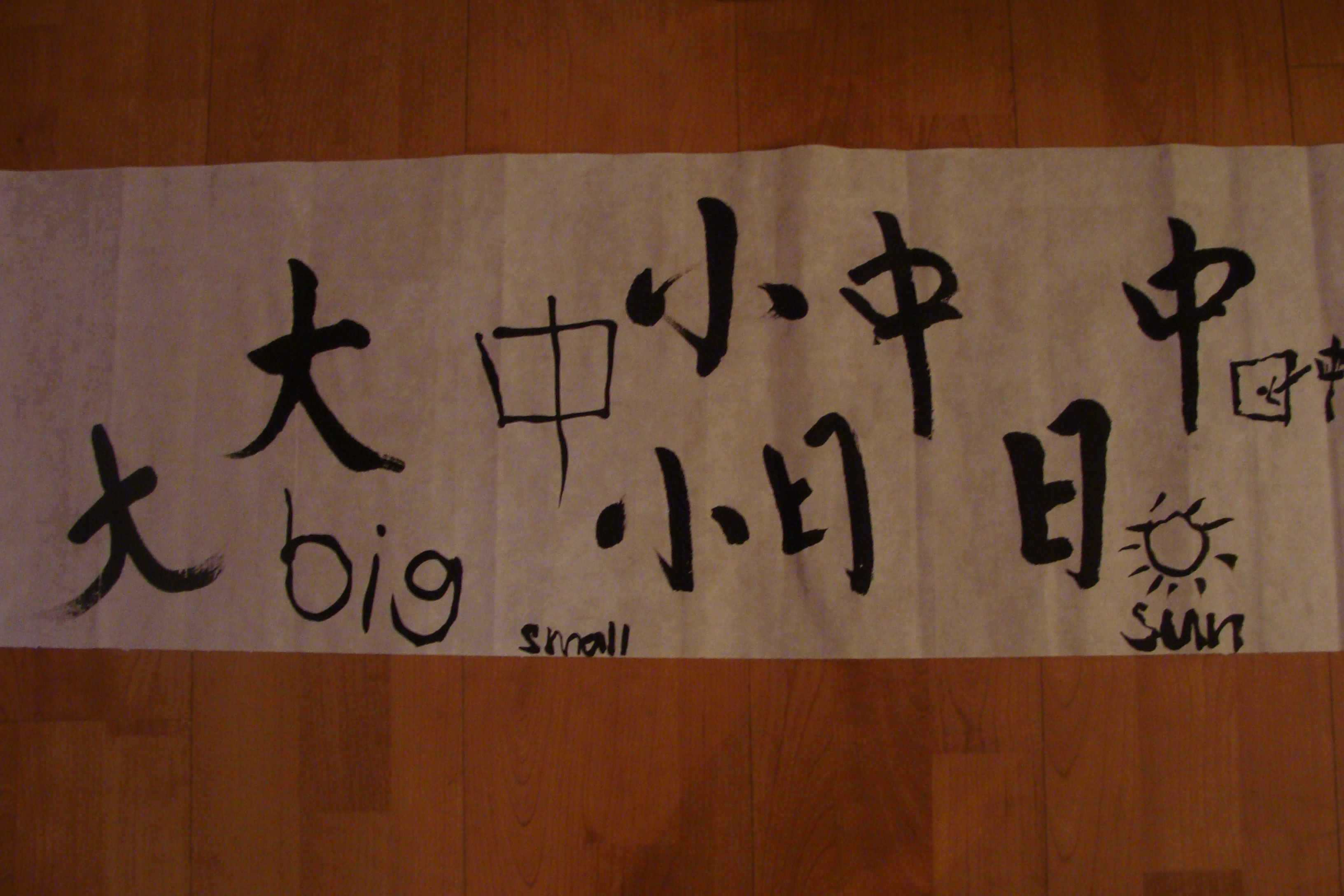
Then it was my turn! Grandfather got out a blank scroll and made the character for middle. He showed me how to hold the brush, which is nothing like holding a pencil. It’s more similar to me to holding chopsticks, but only a little. Mostly, my hands do not have muscles developed to hold something in that way. So interesting! My inclination was to try to hold it at an angle to the paper, but I was corrected to hold it straight up and down. Hai Yu pointed out the order in which to draw the lines from grandfather’s examples. They said I was quite good at it, but I’m pretty sure they were just being polite. Then Joe tried it. Hai Yu said that really, he is too young to learn the calligraphy, but maybe he will learn when he was older. She was so matter of fact when she said most young people do not learn it and it is a skill that is disappearing. To me, this seems like a cultural tragedy! She did say that some young people are becoming interested and starting to learn.
Joe very much used the point of the brush, so his characters were very thin, and did not have the variation of line size. The three of us also did the characters for sun, big and small. Joe then used the brush to spell the words in English under the Chinese characters. He knew how to spell big, and his mom told him the letters for small and sun. For middle, he drew a diagram—a square with a dot in the middle, with an arrow pointing to the dot! Then he painted a sketch of the sun as well!
Then the family presented me with a special gift that grandfather had taken a whole week to make—a special scroll that had Jennifer spelled out in Chinese characters, above the word teacher. The saying in the center was referred to a saying that teachers are like a garden and students are like trees, but also that I am a teacher who has students all over the world! Wow! Also, it was written in seal script, while my name and the date and grandfather’s script was written in running script. Seal script is the 2,000-year-old version of the characters, while running script I think is more like modern cursive. Wow! (There is also standard script, which is more like printing or the typed version of characters.) I do not think I have ever received a more amazing gift! It is like a piece of history and a work of art!
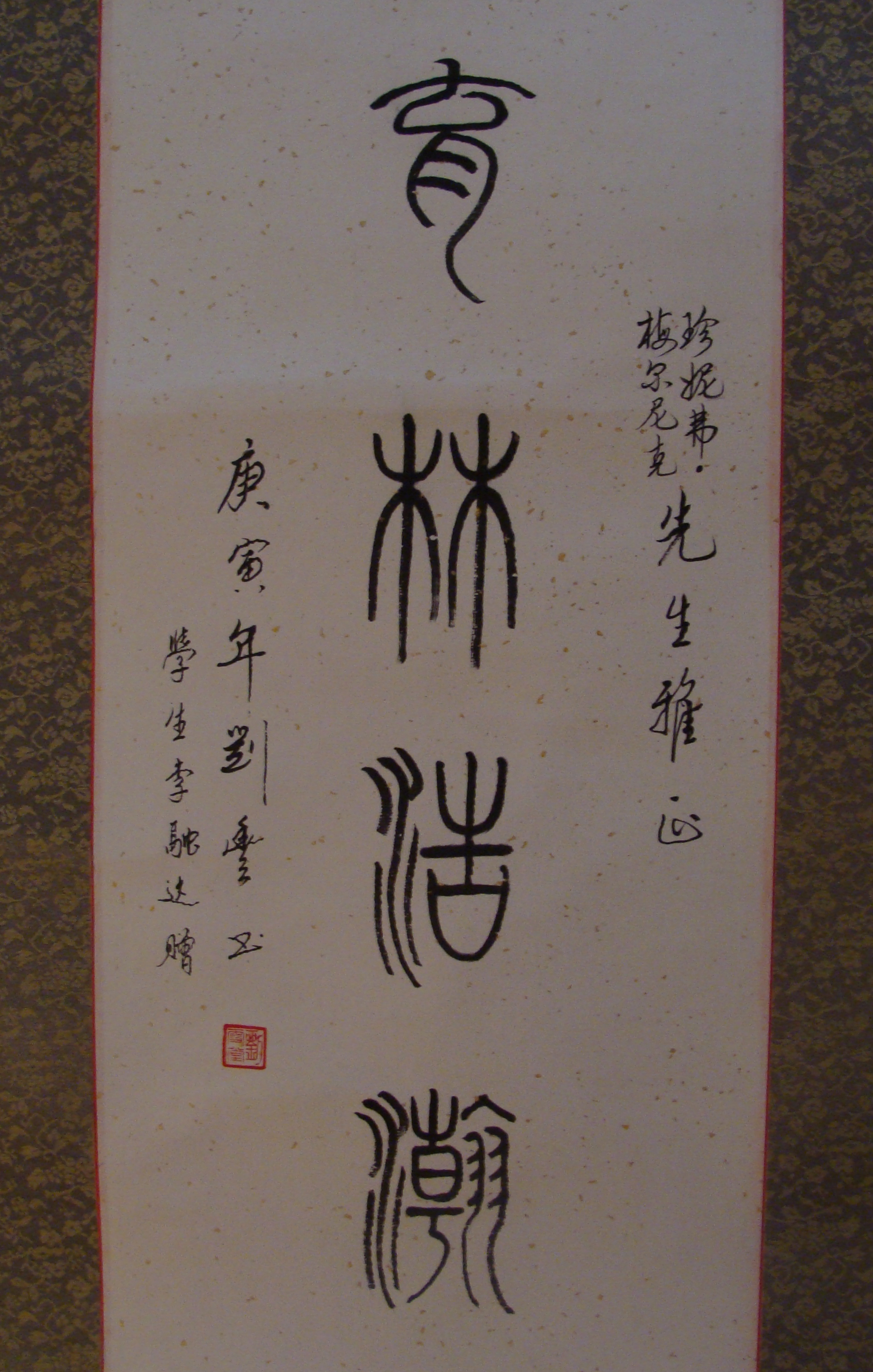
Wow!
Then we all went out for lunch. In the car, Joe played with a small stuffed bear and a duckling. He taught me how to say little bear (xiao xiong) and little duckling (xiao ya zi). Lunch was very exciting, because I knew where we were! The restaurant was right next to one of the places we have gone for foot massages! Hai Yu explained that it was a Peking restaurant, food in the style of Northern China. It was so nice to go to a place and be able to get some background information about it! That is something we have virtually none of on this trip! Lunch was delicious! Though it has been a little disappointing to find out that almost everywhere else has better food than at our hotel. We started with boiled peanuts and millet congee, which is almost like cream of wheat, but not really creamy. It is very good with soy sauce and pickled something added to it. The tomatoes with sugar and mustard greens were similar dishes to ones I’d eaten at our hotel, but they tasted fresher. We had three types of “Chinese pie.” One was thin layers of dough with leeks. I’ve had it several other places. Another was almost exactly like Navajo fry bread, though with less oil. We had the salty kind (not salty at all) and the sweet kind, which was only a little sweet. Another way to describe it would be like beignets without the powdered sugar. But both were delicious! The third pie was like a fried tortilla wrapped in a very thin cooked egg with something, maybe a little cinnamon, very yummy on the inside.
Another dish was crispy rice with sweet and sour vegetables. There was savory tofu, and dumplings with leeks. There was another sweet dish. I think it was taro, with blueberry sauces. They definitely agreed it was a root vegetable. Joe’s dad tried to find a translation on his phone, but couldn’t. When I suggested taro, he looked that up on his phone to check, but that didn’t come up either. So it was a root vegetable, maybe steamed, as it was not crisp and not mushy either, with a blueberry sauce. As we got up to leave, there was still some left, and Joe slurped it right out of the dish! He was kind of bored at the restaurant, like most six year olds with a bunch of adults.
It seemed like Joe did not think this was the greatest visit in the world, but I had a wonderful time! It is such a unique opportunity to spend the day in the home of people who actually live in the country you are visiting, and this family felt exceptional to me. We have arranged to go hiking up the mountain with 2,000 steps next Saturday morning, and I very much look forward to it. I can’t wait to hear about the visits of the other teachers to other families. Could they all be so culturally and historically rich? They said they were very honored to have me as a guest, but I was truly the lucky one!
Update: Patti got worked over at a two-hour badminton lesson! A fascinating day was had by all!
Ahhhhh….
By admin | July 21, 2010
So one thing that is awesome about China is massages. Imagine the density of tattoo places in PB, and that is about the same as the number of spas near us. One we like has the slogan “Pedicure Preventative Health Palace.” I don’t know if they’ll actually paint your toenails, but they will pound your feet into submission. It’s not a foofoo massage; it’s traditional Chinese reflexology. I think there are so many places because it’s a normal part of staying healthy here. For us, it’s also super cheap—less than ten dollars for an 80-minute foot massage that includes shoulder and back massage as well, while your feet are soaking.
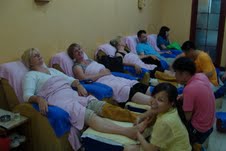
Foot massages are a social event. And they always turn the TV on for us too.
I feel a little exploitative to not only pay so little, but to also be able to show up with a group of ten people at 9:00 at night and for everyone to get massages with no waiting. But that’s the way it works here, so I have had an average of two massages a week. There are several people in our group who have developed illnesses over the last week, and I think I still feel fine because of my foot massage preventative care. Our school doctor recommended massages for the sick teachers as well.
Almost all of the teachers have tried at least one massage, and not everyone has liked it. Because of the way we show up in a large group, the quality does seem to vary a bit. Last week, one of the women got a very sad foot massage from a massage therapist who wouldn’t touch the bottom of her feet. And since we can’t really communicate in Chinese, it’s tricky to address such a thing.
But I have generally loved them! The reflexology is pretty darn painful, as you’ll know if you’ve ever had it done traditionally. But I had read an article mentioning that before we left, so I was ready. It still hurts enough to make my leg twitch, but I feel like I have new feet when I’m done. Some of the others would rather it did not hurt so much. The shoulder and back work also often include a thai-massage style bending you back over the knees sort of thing that not everyone has been comfortable with as well. Luckily, doing acroyoga has uniquely prepared me for enjoying massages here. I’m used to awkward thai massage positions and to being manhandled.
But tonight’s massage stood out! I have an S-curve in my spine from scoliosis, which I manage with yoga, but at this point it’s really not getting better or worse. I usually like to discuss with massage therapists, but here I just figure they’ll notice. Tonight I felt like my therapist made a serious attempt to straighten it out. Wow. There was a lot of pushing my spine side to side. I even started to get a little nervous. But I felt like, if I went back often enough, she could really make some progress on it.
Then there began much discussion among the therapists. Ann was with us and understood enough that she thought they were talking about the hair on my legs and a string. Maybe they were recommending waxing? My therapist was very insistent. She went and got someone who showed us two sticks that looked like a pencil one inch in diameter, maybe made out of stone. She said in English, “hot” and “good.” It seemed not just like an upsell, but important. I said OK, having no idea what I was agreeing to.
After a while, the therapists disappeared and returned with trays with the sticks, which were now burning, not on fire, but glowing hot at the end. They smelled kind of like sage. Maybe we were going to get our legs smudged. Whatever it was, it was going to be Ann and Patti, too, not just me. They said they were up for it. And, when she smelled the burning sticks, Patti realized she was familiar with this type of energy work. They circled the glowing sticks above our knees, down our legs, and back and forth on the bottom of our feet. Sometimes it was close enough to hurt, but not burn. Whenever I flinched, they moved it away. The smoke in our eyes was a bit uncomfortable, but it seemed nice.
When we got home, Patti did a little googling to come up with the name: moxibustion. It is a bundle of mugwort. It is believed to pre-date acupuncture. Some believe it is more effective than acupuncture for moving energy around without it leaking around the needle holes.
That turned out to be a bit of an adventure, and healthy too! I wonder what my next foot massage will bring. I’m sure I’ll need another one in a few days! (I’ve been told it isn’t a good idea to have one every day. Drat.)
I just got back from my first yoga class in China. I love to go to yoga classes when I travel, but til now I have just been doing a little flow or small amount of acro training in my room while getting used to our schedule and the area.
Tonight I ventured out to the gym above the grocery store I like, which, by the way, is not Walmart. (After initially being enchanted by the Chineseness of Walmart, my second visit was overcrowded and miserable, and I will not being going back.)
Anyway, I arrived early for the 7:20 class, having skipped dinner at the hotel, which they are now cracking down on, only to find that they have changed the schedule. It wouldn’t be China for me if the schedule wasn’t changed, though I’m not sure if that’s inherent to China or the organization I’m working for.
I took the 15 minute walk back to the hotel, blogged a bit, and got there just in time for the 8:30 class. It was full, so I got to be on the platform in the front of the room with the teacher. I can’t compare it to any other classes here yet, but in this one we held poses for probably at least three minutes. Whew. That is not usually my favorite way of doing yoga, but I had kind of prepared myself to be ready for anything. (I have been to some great yoga classes while traveling, as well as some truly awful ones. It doesn’t help to fight it.)
No standing poses, though. We started out with half-lotus/half-hero, then on to lizard, downward facing puppy, sphinx, frog, plow, happy baby, side twists, and savasana. It was maybe yin yoga, which I have been meaning to get to a class of for a while at home, but haven’t.
The male teacher had a lovely, deep, calm voice, which was extra nice because people speaking Chinese just normally often sound like they’re yelling when you are not used to hearing the language. I’m pretty sure he counted to twenty at the end of each pose. I thought it might be a good opportunity to learn to count in Chinese, but I couldn’t concentrate past three.
Of course I didn’t have any good guess as to what he was saying the rest of the time. It may have position corrections, but I imagined it could just as well have been lovely Chinese stories, or maybe some wonderful insights like Kristen Watson gives in her class. It wasn’t Mara encouraging me to hold perfectly still for five minutes, though, so I felt pretty free to fidget.
I am really looking forward to a few more classes while I’m here!